A wellness room at work is a private, bookable-or-walk-in space where employees can step away for a few minutes to decompress: sit quietly, breathe, meditate, stretch, or just not be perceived for ten minutes. It is one of the cheapest structural wellbeing moves a company can make, and also one of the most commonly wasted, because most wellness rooms fail on rules and culture, not furniture.
The demand side is real: roughly 1 in 3 U.S. workers say their job makes them stressed always or often, and micro-recovery works best when it has somewhere to happen. Mental Health America recommends dedicated wellness spaces as a practical, stigma-reducing workplace support. This guide covers the three budget tiers, the ground rules that decide whether the room gets used, and how to launch it so it does not become a storage closet by Q4.
In this guide, you'll learn:
- The three tiers: quiet room, wellness room, and recharge lounge, with realistic budgets
- What to put in the room (and what to leave out)
- The five rules that determine whether anyone actually uses it
- How the room fits the law, lactation space, and your broader program
Tier 1: the quiet room (under $500)
Answer-first: you do not need a budget to start, you need a door. Take one small meeting room or unused office and change three things: remove it from the booking system (or rename it "Quiet Room, no meetings"), swap the fluorescent light for a warm lamp, and add one genuinely comfortable chair. Post simple rules on the door: no calls, no meetings, no explanations needed.
That last phrase matters most. The room's job is permission; an employee should be able to spend ten minutes there without narrating why.
Tier 2: the proper wellness room ($1,000-5,000)
Upgrade the quiet room into a space people seek out. Worth the money: a reclining chair or floor cushions, dimmable warm lighting, a small speaker or noise-masking, a basket of low-stimulation props (eye masks, a soft blanket, a printed breathing card like our Desk Reset), plants, and a visible timer so nobody watches the clock. Skip: TVs, ping-pong energy, motivational posters, and anything that turns rest into content.
Two practical notes. First, if the room doubles as your lactation space, nursing employees have legal priority: U.S. employers must provide a private, non-bathroom space under the PUMP Act, so either keep those functions in separate rooms or give the lactation schedule precedence explicitly. Second, put the room somewhere with acoustic separation; a meditation space next to the sales floor serves nobody.
Tier 3: the recharge lounge (facilitated, from $1,250)
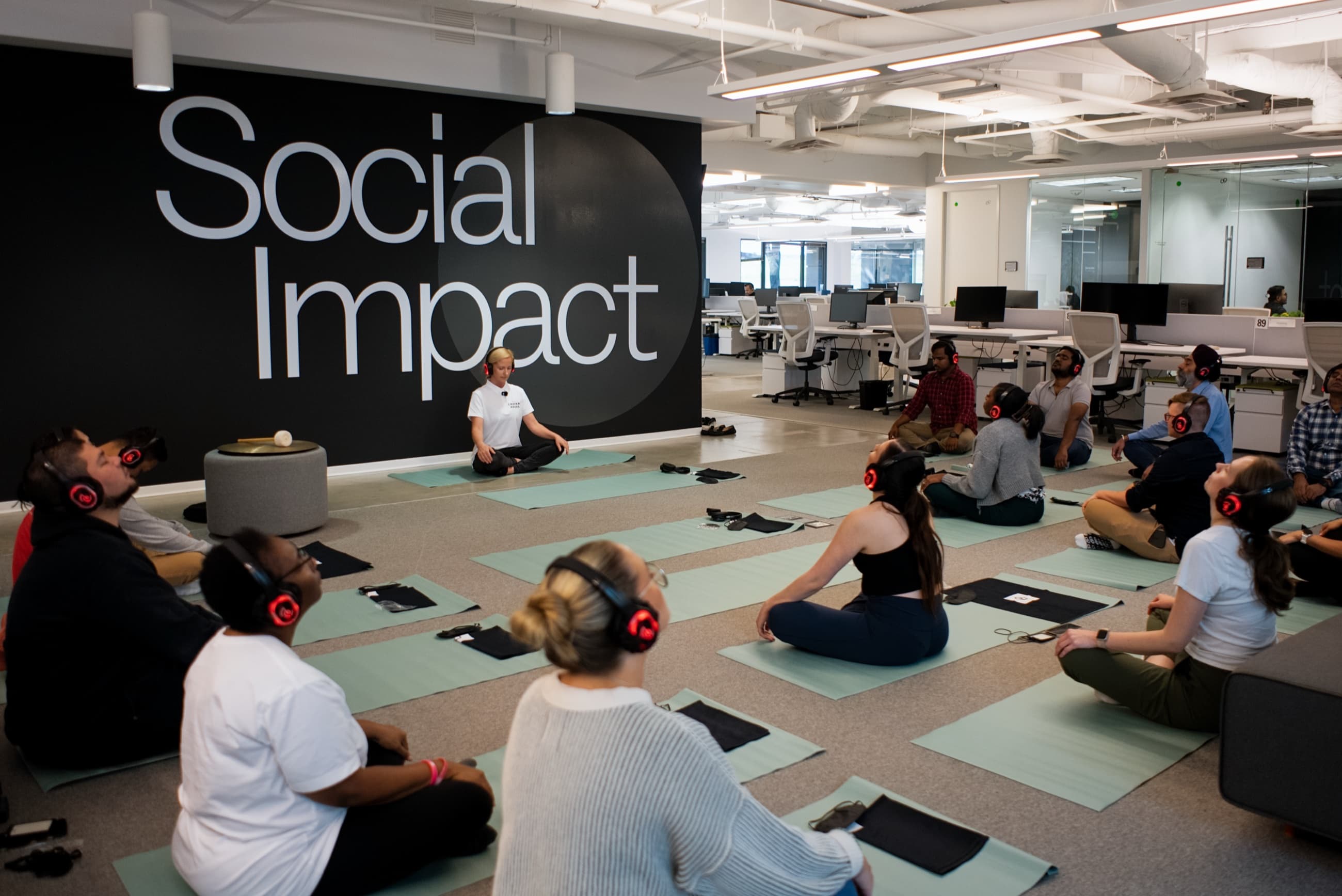
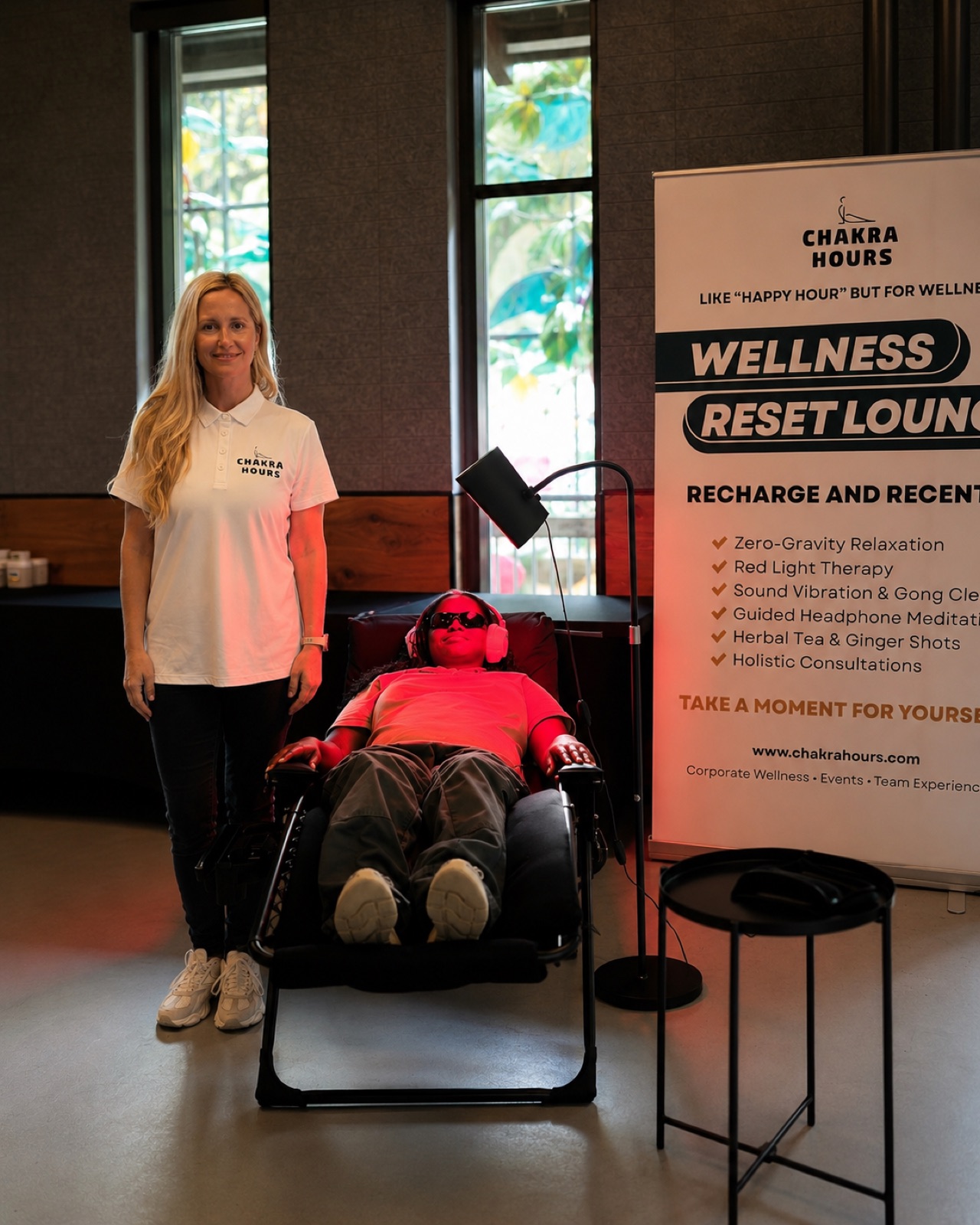
The ceiling version is not a room at all, it is an experience: multiple restorative stations running at once, staffed so employees just show up. This is exactly what our Wellness Reset Lounge does as a pop-up: zero-gravity recharge chairs, red light, headphone-guided meditation, live sound, and herbal tea, set up in your office, conference, or health fair from $1,250. Companies use it two ways: as a recurring monthly "recharge day" that gives the wellness room concept a heartbeat, or as the launch event that teaches everyone what the permanent room is for.
If you are planning it as part of a bigger employee event, the lounge is also the most-queued station at corporate health fairs.
The five rules that decide if it gets used
- Name it plainly. "Quiet Room" or "Reset Room" beats anything cute. People need to know what it is for from the hallway.
- Protect it in the calendar system. The day it hosts one "quick sync," it is a meeting room again forever.
- Have leaders use it visibly. One director taking ten minutes there per week does more than the launch email.
- Set the no-explanation norm. Nobody should have to justify a reset. Say that sentence in the launch comms.
- Launch it with a live session. An empty room asks people to invent a practice. A facilitated first week, guided meditation or breathwork in the space, teaches the habit; it is the single best predictor we see of a room still being used six months later. That practice layer is what our live corporate wellness sessions are for.
What about small or fully remote offices?
No spare room? Create quiet hours instead: two protected afternoon hours, twice a week, plus desk-level micro-breaks from the free Desk Reset card. Fully remote teams skip the room and keep the ritual: a recurring 20-minute guided reset on Zoom does the same job the room does onsite. Both fit into the broader menu of mental health activities for employees.
Frequently asked questions
What should be in a wellness room at work?
A comfortable chair or recliner, warm dimmable light, quiet, a few low-stimulation props (eye mask, blanket, breathing card), and posted rules: no meetings, no calls, no explanations needed. Everything else is optional.
How big does a wellness room need to be?
One person at a time needs little more than a large closet's footprint; 60 to 100 square feet is plenty. A multi-station recharge setup wants a small conference room or open corner.
Do employees actually use wellness rooms?
They use rooms that are protected, normalized by leaders, and launched with a guided practice. Rooms fail when they stay bookable as meeting space or when using them feels like a confession. The five rules above are the difference.
Is a wellness room the same as a lactation room?
No. A private, non-bathroom lactation space is a legal requirement for U.S. employers under the PUMP Act; a wellness room is voluntary. One room can serve both only if nursing employees get explicit scheduling priority, and separate rooms are the cleaner setup.
Give the room a heartbeat
A wellness room works when something regularly happens in it. We launch and sustain them with live facilitated sessions and the pop-up Wellness Reset Lounge, onsite across Dallas-Fort Worth. Tell us your space and headcount and we will suggest a setup within one business day.
This article is for informational purposes only and is not a substitute for professional medical or legal advice.