The ChakraHours WorkdayReset Method™.
A 4-pillar framework for sustainable workday wellbeing, built on stress physiology research, polyvagal theory, and what actually works in real teams.
Reset · Restore · Resource · Renew
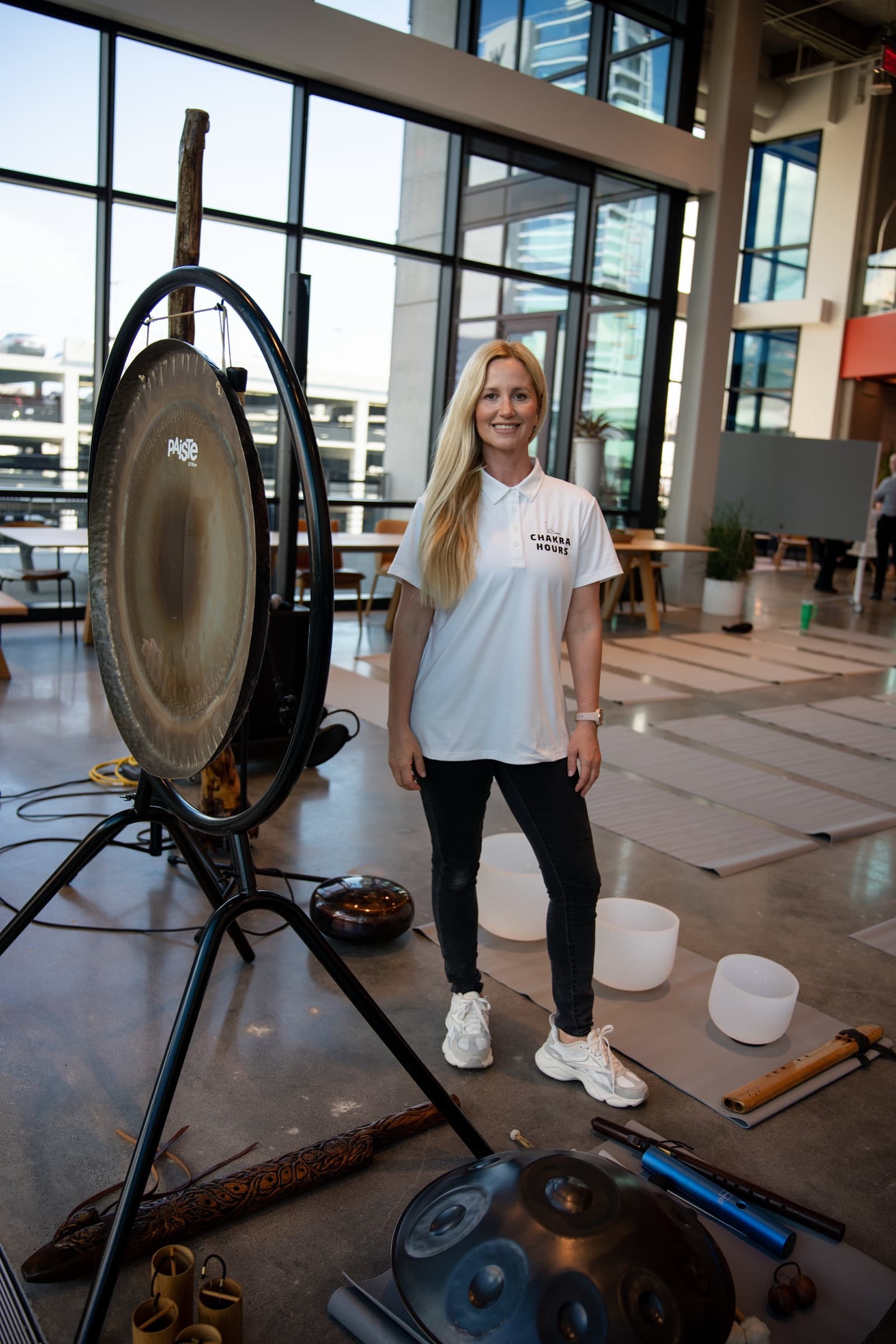

Measurable physiology.
The Workday Reset Method™ maps each pillar to a documented physiological mechanism: vagal tone, heart rate variability, cortisol, and sustained attention. It draws on decades of peer-reviewed research from Harvard, Mass General, UMass, and the original polyvagal literature, and it powers every live corporate wellness session we run. For the workday science in plain English, see why the 2pm reset works.
Polyvagal regulation
Breath, sound, and gentle movement directly activate the vagus nerve, shifting the body out of sympathetic stress and into parasympathetic recovery.
Porges, S. W., The Polyvagal Theory
HRV + cortisol
Heart rate variability and cortisol are the trackable biomarkers of stress recovery. Meditation has been shown to reduce heart rate, triglycerides, and cortisol.
Harvard T.H. Chan School of Public Health
Sustained attention
Trained meditators show more sustained gamma oscillations in the brain, the wave pattern linked to memory, focus, and emotional regulation.
Harvard Graduate School of Arts and Sciences
Named studies.Honest claims.
The specific research behind the practices we teach, with what each study found and what it does not claim. Forward this to the most skeptical person on your leadership team.
The physiological sigh
In a month-long randomized study at Stanford, five minutes a day of cyclic sighing, the exhale-weighted breath we teach in Breathwork for Focus, improved mood more than an equal dose of mindfulness meditation and lowered resting respiratory rate.
Balban, Neri, Kogon et al. (2023). Brief structured respiration practices enhance mood and reduce physiological arousal. Cell Reports Medicine, 4(1).
What it doesn’t claim: Measured in healthy adults via mood scales and breathing rate. A daily-practice effect, not a medical outcome.
Live sound meditation
After a single singing-bowl sound meditation, participants reported significantly less tension, anger, fatigue, and depressed mood, and first-time listeners felt the biggest drop in tension.
Goldsby, Goldsby, McWalters & Mills (2017). Effects of Singing Bowl Sound Meditation on Mood, Tension, and Well-being. Journal of Evidence-Based Complementary & Alternative Medicine, 22(3).
What it doesn’t claim: Self-reported, single-session results. We deliver sound as deep rest and recovery, never as therapy.
Completing the stress cycle
Stress is a physiological cycle that needs a physical completion signal, movement, breath, or connection, not just the removal of the stressor. This is why every Chakra Hours session ends in the body, not on a slide.
Nagoski, E., & Nagoski, A. (2019). Burnout: The Secret to Unlocking the Stress Cycle. Ballantine Books.
What it doesn’t claim: A research synthesis rather than a single trial; we teach it as a working model employees can apply the same day.
Mindfulness at work
Across 23 randomized controlled trials, workplace mindfulness training produced reliable improvements in employee stress, psychological distress, and wellbeing.
Bartlett, Martin, Neil et al. (2019). A systematic review and meta-analysis of workplace mindfulness training randomized controlled trials. Journal of Occupational Health Psychology, 24(1).
What it doesn’t claim: Effects are small to moderate, and burnout findings are more mixed, which is why every program includes its own pre/post measurement.
Micro-breaks in the workday
A meta-analysis of 22 studies found that short, deliberate breaks reliably increase vigor and reduce fatigue during the workday, the premise behind the 30-minute reset and The Desk Reset card.
Albulescu, Macsinga et al. (2022). "Give me a break!" A systematic review and meta-analysis on the efficacy of micro-breaks. PLOS ONE, 17(8).
What it doesn’t claim: Performance gains grow with somewhat longer breaks, which is exactly where a facilitated 30-minute session sits.
Chakra Hours sessions are educational wellbeing programming built on this research. They are not medical care, therapy, or treatment. Full reference list →
Built onThe Workday Reset Method™.
One cycle, four phases. Every Chakra Hours session moves through them, and the curriculum repeats the cycle at three zoom levels.
What each pillaractually does.
Each pillar maps to a defined physiological target, a set of practices employees can name, and a body of research that supports it.
Interrupt the stress cycle.
Brief, deliberate physiological interventions that move the nervous system out of fight-or-flight and back to baseline.
- ✓Box breathing & physiological sigh
- ✓Body scan & grounding
- ✓Sound-based parasympathetic reset
Polyvagal theory · HRV research
Rebuild the energy.
Recovery practices that make the next workday possible. A Reset without Restore is temporary calm; with Restore, it becomes a sustainable cycle.
- ✓Chair yoga & restorative movement
- ✓Sleep & recovery education
- ✓Energy-management rituals
Sleep research (Walker) · Loehr & Schwartz
Send the toolkit home.
Portable 90-second practices employees can use at their desk, before a meeting, in a moment of overwhelm, without ever returning to a class.
- ✓90-second resets & breath patterns
- ✓Tools cards & journal prompts
- ✓Transition rituals between meetings
Habit formation (Fogg) · MBSR (Kabat-Zinn)
Meet the workplace year.
Year-round programming aligned with predictable stress points and awareness moments, so wellbeing keeps pace with the calendar.
- ✓Seasonal & quarterly intensives
- ✓Awareness-month integration
- ✓Year-end deep-reset programs
Chronobiology · organizational psychology
From 30 minutesto a full year.
The same four pillars repeat across a single live session, a multi-week curriculum series, and the workplace year. So what your team learns in 30 minutes still lands twelve months later.
30 min
A single session
All four pillars surface in one arc: a Reset opener, a Restore practice, a Resource takeaway, a Renew closing intention.
8 weeks
A series
Each session emphasizes one pillar while the other three stay in the structure. Builds the full arc across two months.
12 months
A workplace year
Quarterly anchors align with workplace seasons: Q1 Renew, Q2 Reset, Q3 Restore, Q4 Resource. Awareness months get the matching pillar.
Three documents ship with every session.
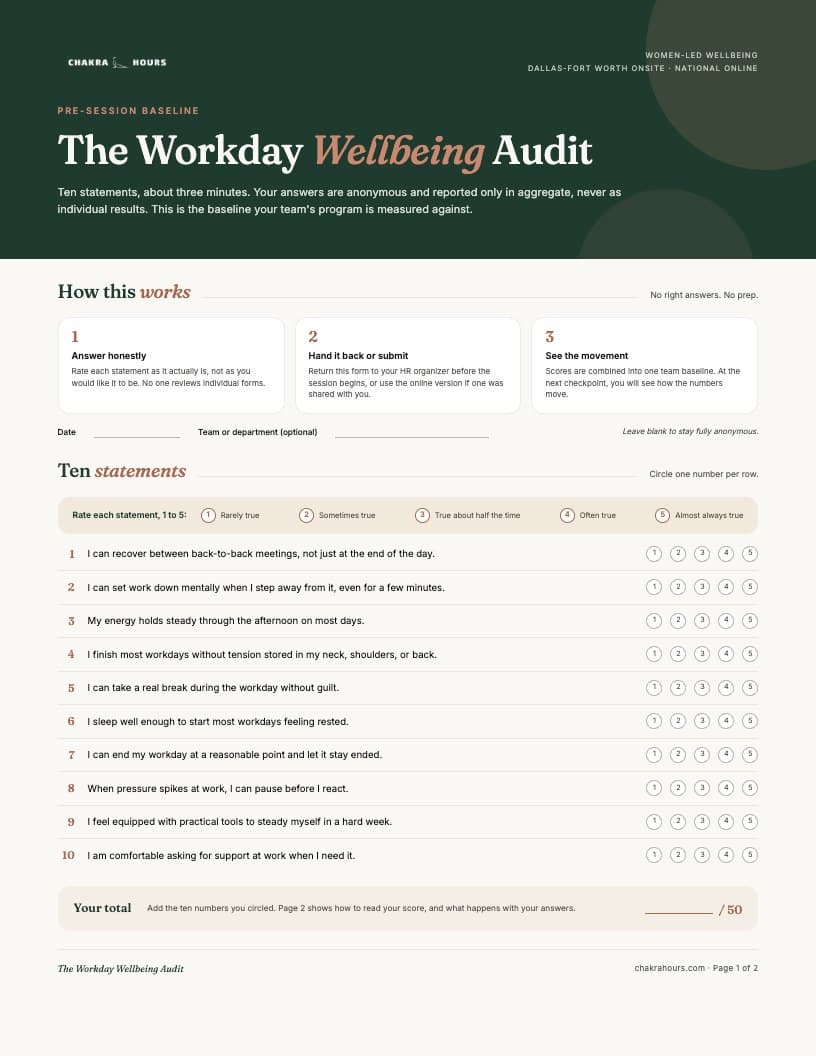
Workday Wellbeing AuditBefore
A 10-question baseline employees complete in three minutes.
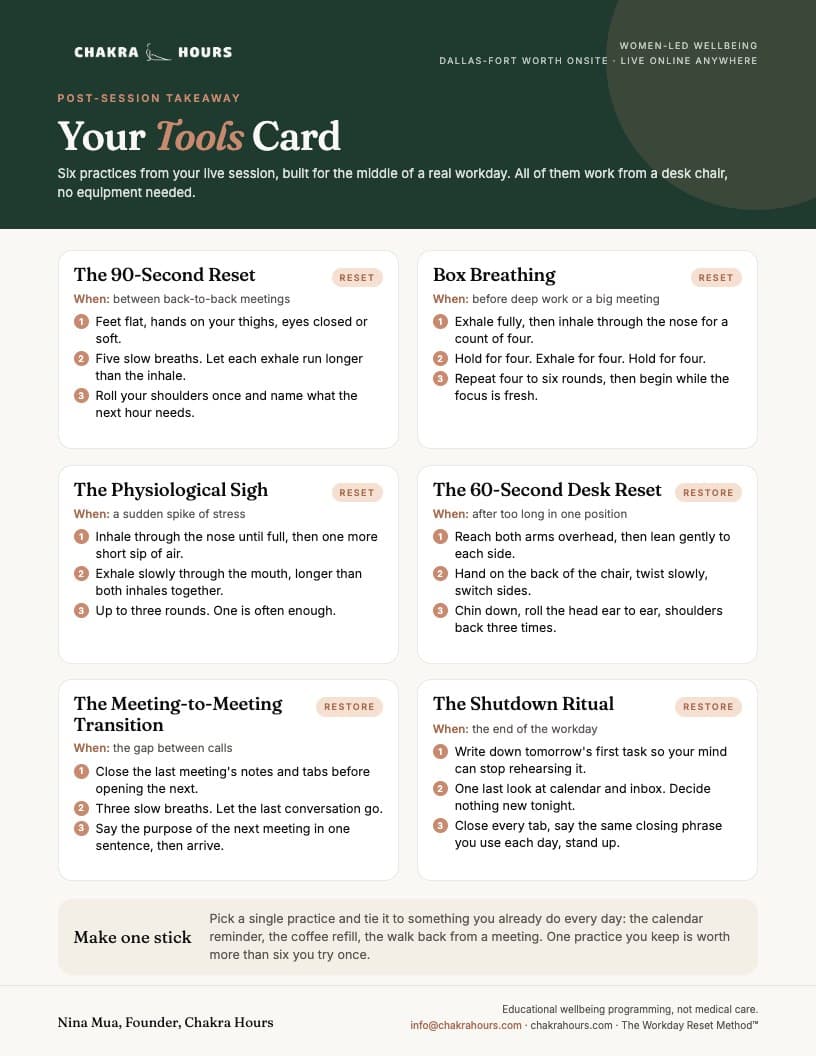
Tools CardAfter
The practices from the session on one page, ready to use from a desk chair.
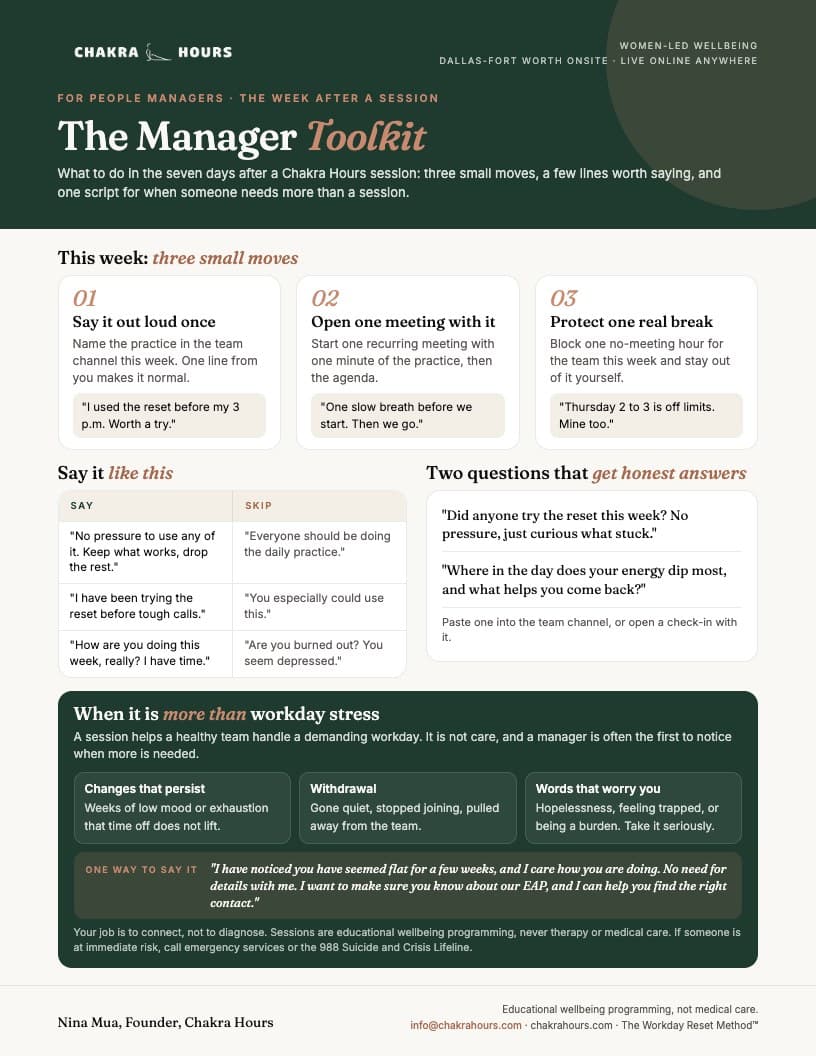
Manager ToolkitManagers
Three small moves and one script for the week after.
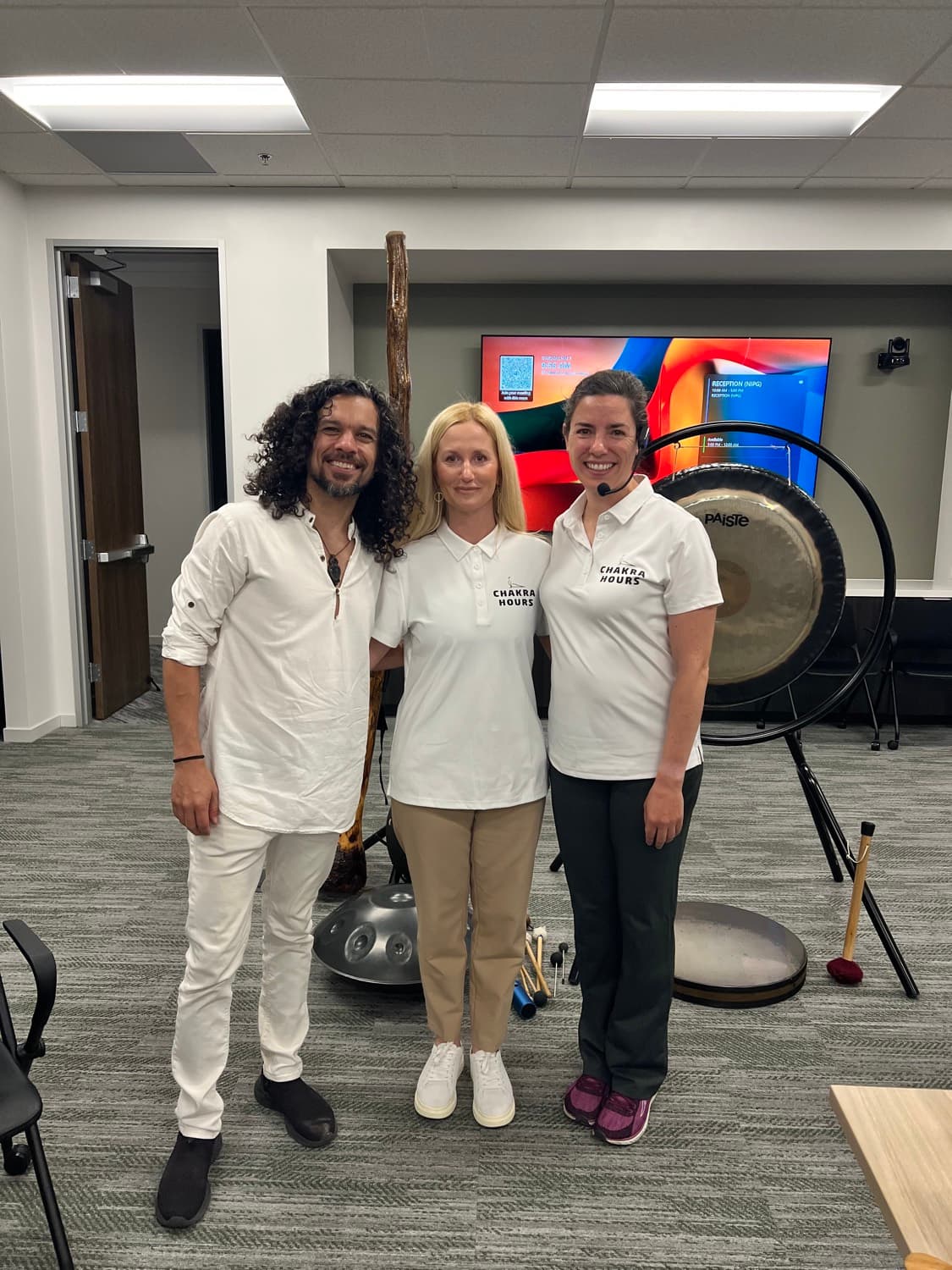
Certified facilitators,trained in the method.
Every Chakra Hours session is led live by a credentialed facilitator: experienced yoga and meditation teachers, breathwork and sound practitioners, fully insured and seasoned with corporate teams.
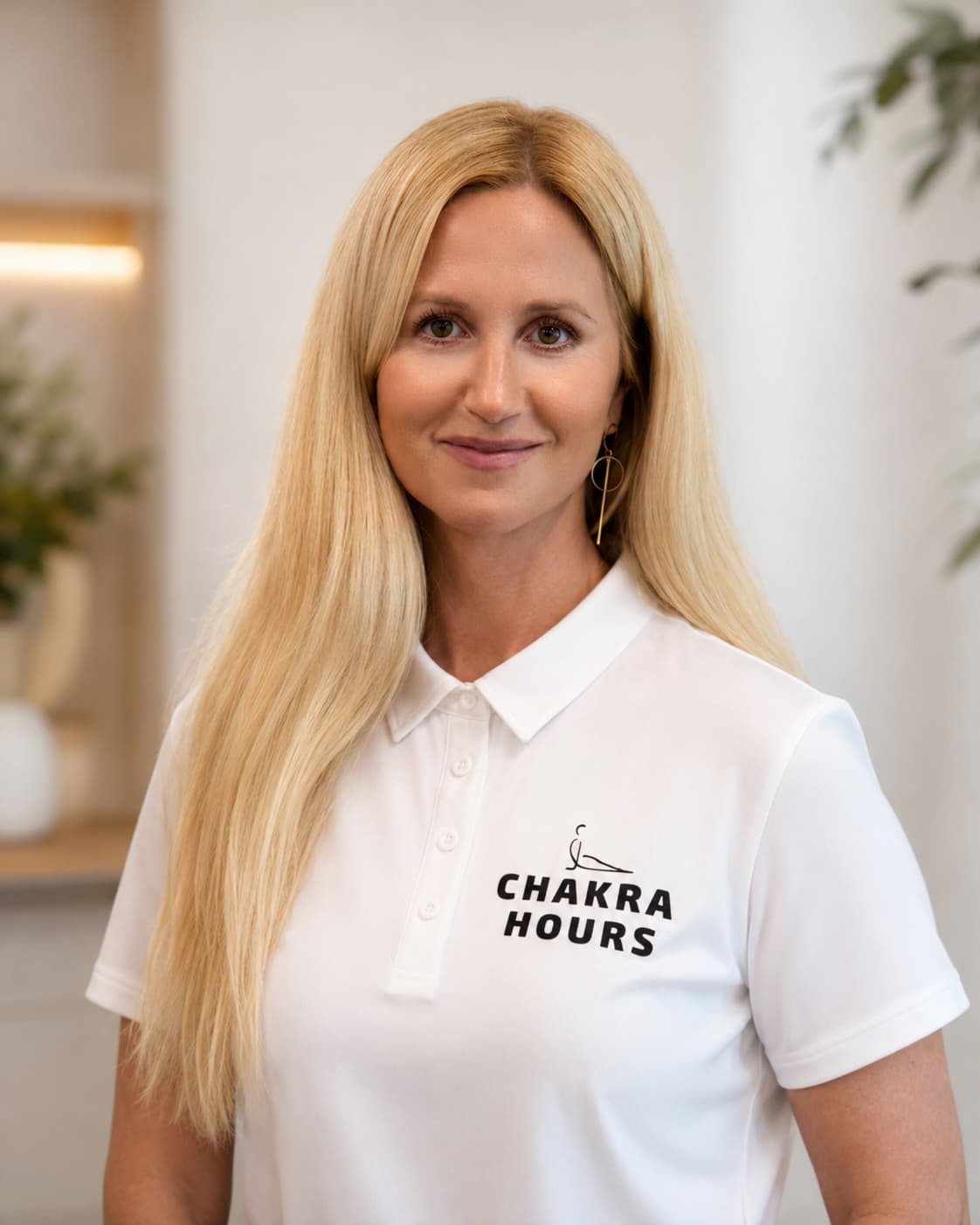
Nina Mua
Founder & Lead Facilitator
Creator of The Workday Reset Method™. Built the curriculum after watching corporate teams burn out without the language or tools to recognize stress in the body.
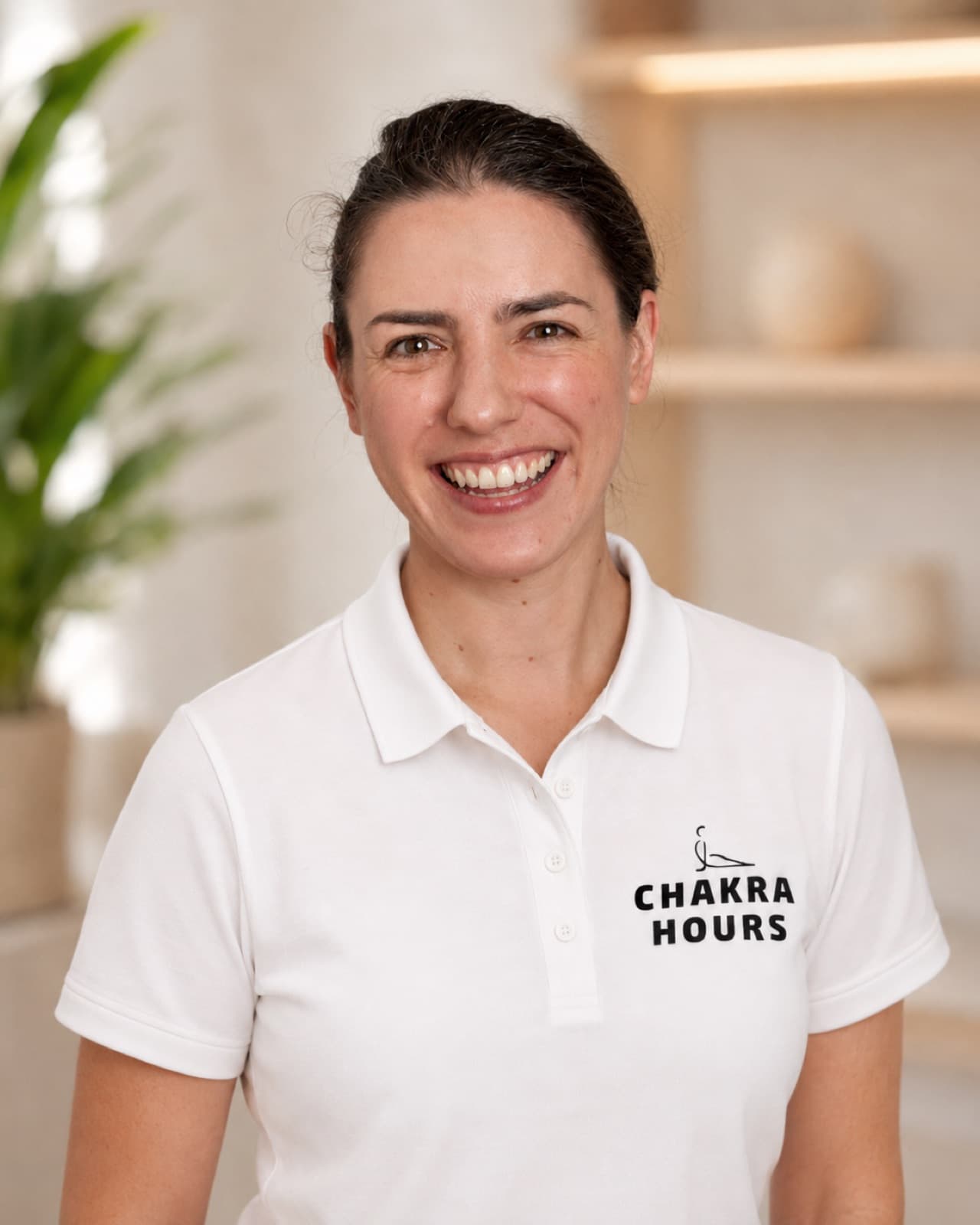
Caroline Besley
Senior Facilitator
Practicing yoga since 1998, teaching since 2012. Dance-informed style focused on healthy alignment. Studies with Jill Miller, Tias Little, and Doug Keller.
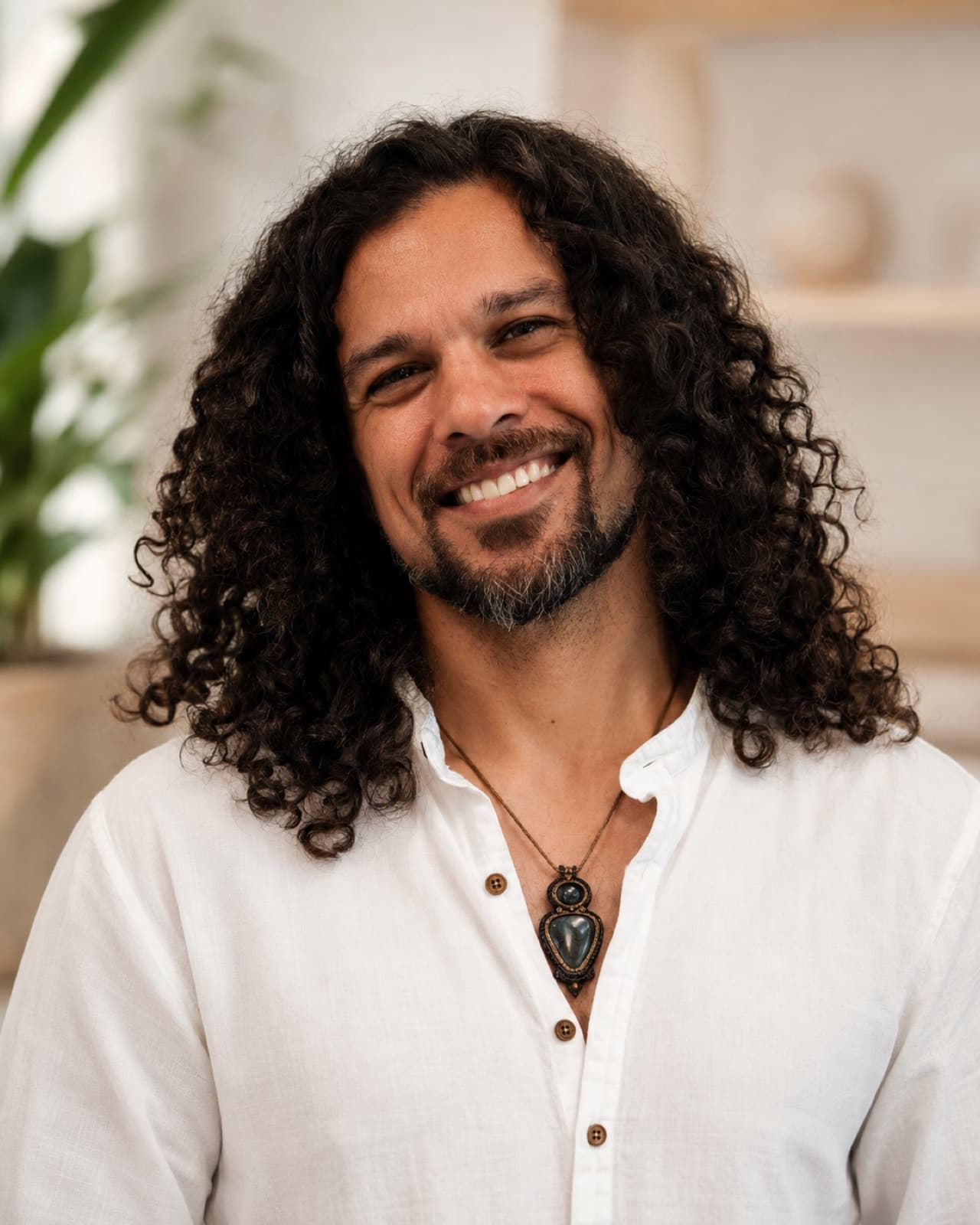
Chris
Sound & Breathwork Facilitator
Certified sound healer trained in instruments from around the world. Also facilitates Authentic Relating and Embodiment work at the Dallas Meditation Center.
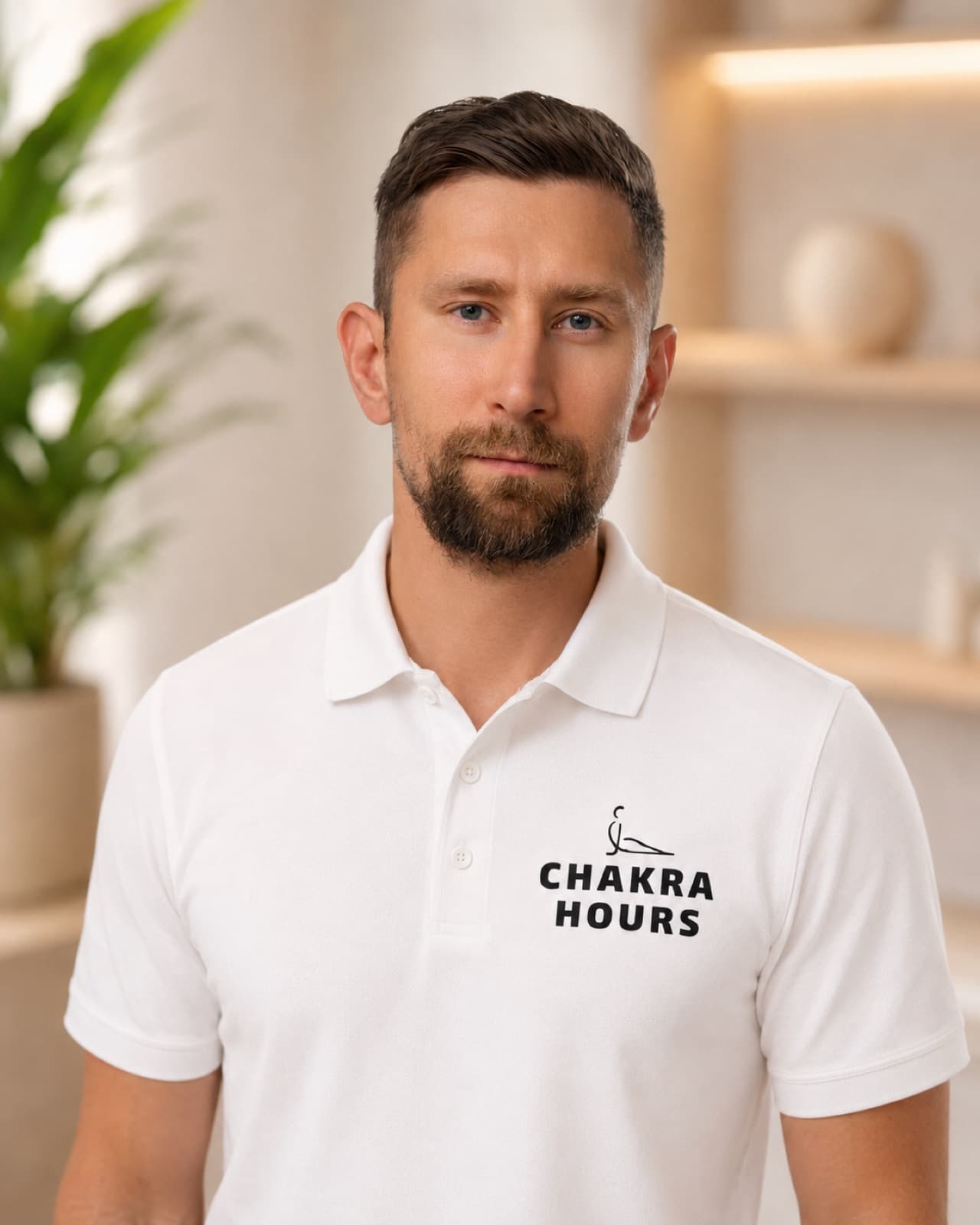
Sam
Facilitator
Works with companies, HR teams, and office environments to bring calm, focused wellness sessions into the workday. Practical, employee-friendly delivery.
“People don’t come to work as job titles. They come carrying their nervous system, their morning, their week. We built the method so the workday could finally meet them there, even for thirty minutes, and remind them they’re a human first.”
Nina Mua, Founder & Lead Facilitator
A quick win you can send your team today.
The Desk Reset is a free printable card of six short, desk-friendly resets, built on The Workday Reset Method™. No app, no equipment, nothing to schedule, a simple way to put wellbeing in front of your people right now.
Selected researchbehind the method.
The Workday Reset Method™ is built on a body of stress physiology, neuroscience, and recovery research. Selected sources below.
Breathwork (cyclic sighing)
Balban, M. Y., Neri, E., Kogon, M. M., et al. (2023). Brief structured respiration practices enhance mood and reduce physiological arousal. Cell Reports Medicine, 4(1).
Sound meditation
Goldsby, T. L., Goldsby, M. E., McWalters, M., & Mills, P. J. (2017). Effects of Singing Bowl Sound Meditation on Mood, Tension, and Well-being: An Observational Study. Journal of Evidence-Based Complementary & Alternative Medicine, 22(3).
Workplace mindfulness RCTs
Bartlett, L., Martin, A., Neil, A. L., et al. (2019). A systematic review and meta-analysis of workplace mindfulness training randomized controlled trials. Journal of Occupational Health Psychology, 24(1).
Micro-breaks & recovery
Albulescu, P., Macsinga, I., Rusu, A., et al. (2022). "Give me a break!" A systematic review and meta-analysis on the efficacy of micro-breaks for increasing well-being and performance. PLOS ONE, 17(8).
Stress-cycle completion
Nagoski, E., & Nagoski, A. (2019). Burnout: The Secret to Unlocking the Stress Cycle. Ballantine Books.
Polyvagal & nervous system
Porges, S. W. (2011). The Polyvagal Theory: Neurophysiological Foundations of Emotions, Attachment, Communication, and Self-Regulation. W. W. Norton & Company.
MBSR (mindfulness-based stress reduction)
Kabat-Zinn, J. (2013). Full Catastrophe Living: Using the Wisdom of Your Body and Mind to Face Stress, Pain, and Illness. Random House.
Workplace meditation research
Massachusetts General Hospital, Meditation Research Program (M. Sacchet, Director) and the Center for Anxiety and Traumatic Stress Disorders (A. Baker, Director).
Stress biomarkers
Harvard T.H. Chan School of Public Health, research on meditation effects on heart rate, triglycerides, and cortisol.
Attention & neuroplasticity
Jha, A. P. (2021). Peak Mind: Find Your Focus, Own Your Attention, Invest 12 Minutes a Day. HarperOne.
Sleep & recovery
Walker, M. (2017). Why We Sleep: Unlocking the Power of Sleep and Dreams. Scribner.
Energy management
Schwartz, T., & Loehr, J. (2003). The Power of Full Engagement. Free Press.
Habit formation
Fogg, B. J. (2019). Tiny Habits: The Small Changes That Change Everything. Houghton Mifflin Harcourt.
Burnout (occupational)
World Health Organization (2019). Burn-out as an "occupational phenomenon" (ICD-11).
The Workday Reset Method™ draws on this body of research while remaining a wellness education program. It is not medical care, therapy, or treatment.
Bring The Workday Reset Method™
to your team.
Start with the live curriculum, or run a custom onsite or quarterly program.