Sleep education for employees is a short, structured program that teaches people how sleep actually works and gives them practical skills, a wind-down routine, caffeine timing, boundaries with screens, they can use the same night. It is the rare wellbeing topic that touches every single employee, every single day, and it does not require a tracker, an app rollout, or a single piece of software.
The size of the problem is well documented. The CDC reports that about one in three U.S. adults regularly gets less than the recommended seven hours of sleep. RAND Corporation researchers estimated that insufficient sleep costs the U.S. economy up to $411 billion a year, and that people sleeping under six hours lose around six more working days a year to absence and reduced output than people sleeping seven to nine. For an HR team, that is not a lifestyle statistic. That is a workforce performance issue hiding in plain sight.
In this guide, you'll learn:
- Why sleep is one of the highest-leverage wellbeing topics HR can program
- What sleep education is, and what it is not
- What a live 30-minute session actually covers
- When to schedule it so it lands, and how to measure whether it worked
Why sleep is HR's highest-leverage wellbeing topic
Sleep sits upstream of almost everything else HR tries to improve. Focus, mood, patience with coworkers, decision quality, even how the body handles stress the next day, all of it runs through the previous night. When teams are underslept, engagement surveys dip, small conflicts get bigger, and the 2pm slump becomes a 2pm wall.
It is also the most personally welcome topic in workplace wellbeing. Nobody feels lectured when you teach sleep. Employees experience poor sleep as a problem they own and want solved, so a session about it reads as a genuine gift rather than a corporate initiative. In our experience running workplace programs, sleep sessions draw questions from people who never speak up in any other wellbeing setting.
And unlike gym stipends or step challenges, sleep education requires nothing from the employee's calendar except the session itself. There is no habit tracker to abandon in week two. The material either changes what someone does at 9:30 tonight or it does not, and good material does.
What is sleep education, and what is it not?
Sleep education is teaching: how sleep pressure builds across the day, what caffeine and screens do to it, why consistency beats duration for many people, and which wind-down practices reliably help. Delivered well, it is plain-English physiology plus a small set of techniques employees can apply immediately.
It is worth being clear about what it is not. It is not sleep tracking, and it is not medical care. Wearables and sleep apps measure the problem without teaching anyone what to do about it, and workplace tracking of something as personal as sleep can feel like surveillance. And genuine sleep disorders, insomnia, sleep apnea, deserve a clinician, not a workshop. A responsible program says that out loud and points people toward their doctor or CBT-I (cognitive behavioral therapy for insomnia, the first-line clinical treatment) when it applies.
That boundary is not a weakness of workplace sleep education. It is what makes it easy for HR and legal to approve.
What a live 30-minute sleep session covers
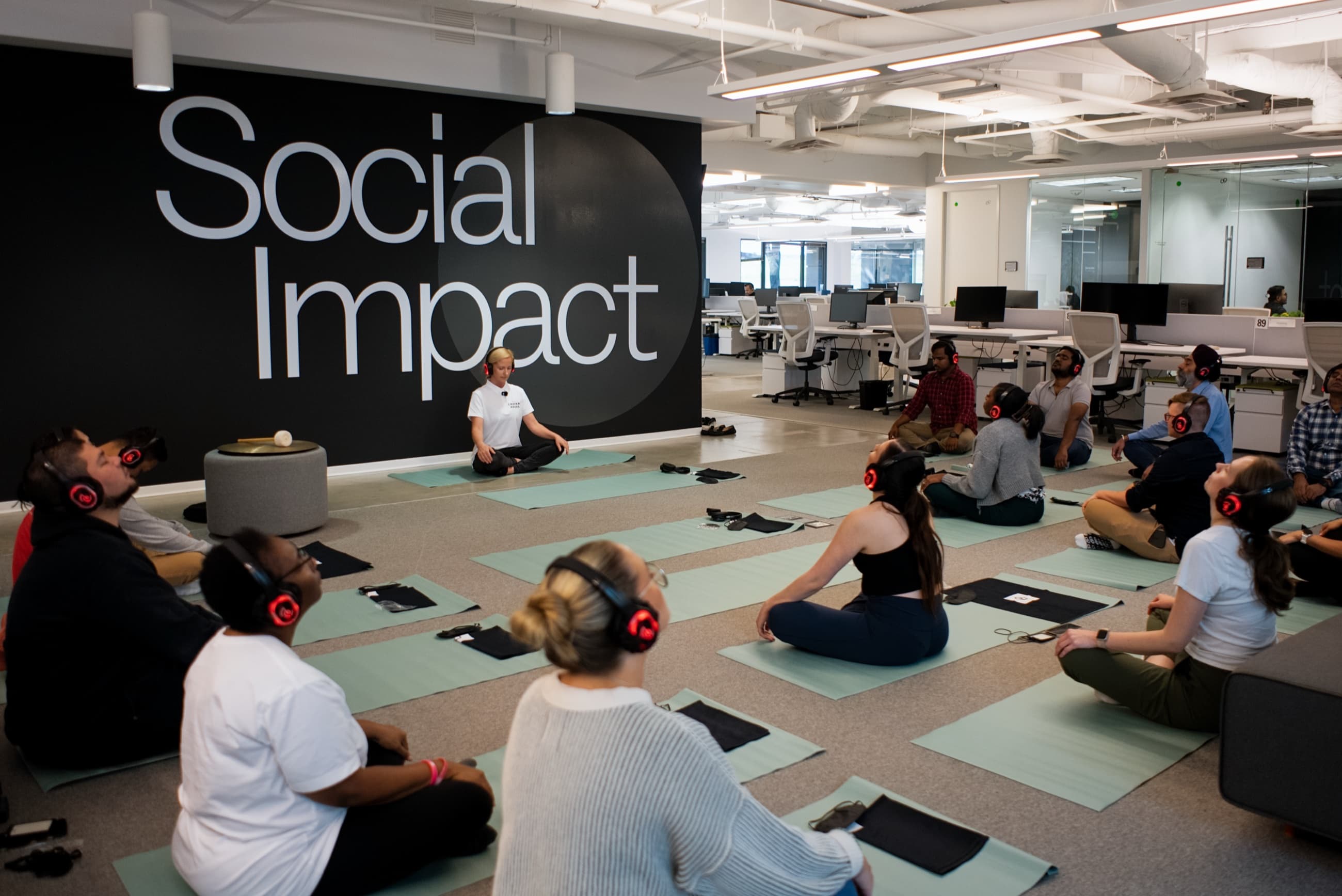
A live session beats a slide deck or a newsletter for one reason: attendance and attention. This is exactly the format of our curriculum session Sleep, Recovery & Digital Overload, one of the twelve sessions in the Workday Wellbeing Curriculum, and here is what a session like it teaches in half an hour:
- How sleep actually works, in plain English. Sleep pressure, the body clock, and why "catching up on the weekend" does not quite work. Five minutes of physiology that reframes the whole topic.
- Caffeine timing. Caffeine has a half-life of roughly five to six hours, which means the 3pm coffee is still half-active at 8pm. Most people change their afternoon habits the same week they learn this.
- The digital wind-down. Screens delay the body's natural evening downshift. Employees leave with a realistic "digital sunset" routine, not a lecture about abandoning their phone.
- A downshift technique they can feel. A short guided practice, slow exhale-weighted breathing, that demonstrates in real time what "calming the nervous system before bed" actually feels like. The research behind the techniques we teach is on our methodology page.
Every Chakra Hours session also ships with a take-home tools card for employees and a manager toolkit, so the 30 minutes keeps working after the call ends. Sessions run live on Zoom or Microsoft Teams for up to 200 people, with no app and nothing to install.
When should HR schedule sleep education?
Timing does a lot of the promotional work for you. The strongest windows:
- Sleep Awareness Week (March). The natural flagship moment, and it pairs with World Sleep Day. Our March awareness calendar for HR maps the month.
- The daylight saving transitions (March and November). The whole company is tired the same week. A session lands as perfectly timed help.
- National Wellness Month (August). A sleep session slots neatly into a Wednesday cadence; see our August awareness days guide.
- After a crunch. Post-launch, post-busy-season, post-open-enrollment. Teams know exactly why they are there.
One session is a strong start; a rhythm is better. Many teams run sleep education as one session inside a broader series, which is how our class packs are structured.
How to measure whether it worked
Skip the wearables. The honest, low-friction measurement stack for a sleep session looks like this:
- Attendance and re-attendance. The single most telling wellbeing metric. If people come back for the next session, it worked.
- Pre/post self-assessment. A short before-and-after pulse, we include a pre-session Workday Wellbeing Audit and post-session check as standard, showing shifts in self-reported sleep quality and energy.
- One behavior question, 30 days later. "Are you still using anything from the session?" A yes rate above half is an excellent result for any workplace program.
That is enough to defend the spend, and it respects the line between supporting employees and monitoring them.
Common mistakes with employee sleep programs
- Buying trackers first. Measurement without teaching changes nothing, and sleep data is the most personal data there is. Education first; gadgets never required.
- The one-and-done lunch talk. A single lecture with no take-home tools fades in a week. Pair any session with written tools and a manager nudge.
- A shaming tone. People with young kids, caregiving duties, or shift schedules cannot simply "sleep more." Good sleep education offers the highest-impact adjustments for real lives.
- Forgetting non-desk teams. Shift and frontline workers have the most acute sleep challenges. If your workforce includes them, say so when you scope the program; the content should flex.
How to get started with Chakra Hours
The lightest way to try sleep education is the Single Session: one live 30-minute session for $695, delivered on Zoom or Teams with the assessment, tools card, and manager toolkit included. If sleep is one of several topics on your list, the 4-Session Series covers a month of programming, and our live corporate wellness page shows exactly how sessions run.
Tell us your timing on the contact form and we'll come back with a scoped recommendation within one business day.
Frequently asked questions
What is sleep education for employees?
It is a structured workplace program, usually a live session or short series, that teaches how sleep works and provides practical techniques for better sleep: wind-down routines, caffeine timing, and screen boundaries. Unlike sleep-tracking perks, it changes behavior by teaching rather than measuring.
How long should a workplace sleep session be?
Thirty minutes is the sweet spot. It is long enough to teach the physiology and practice one technique, and short enough that employees attend during a workday without rearranging anything. Longer workshops work for retreats and wellness days, but attendance drops as duration grows.
Is workplace sleep education medical advice?
No. It is educational wellbeing programming, not diagnosis or treatment. A responsible program explicitly directs anyone with a suspected sleep disorder, chronic insomnia, sleep apnea, severe daytime sleepiness, to a qualified clinician, where treatments like CBT-I are the standard of care.
Does a single sleep session actually help?
A single well-taught session reliably produces immediate changes, most commonly caffeine timing and evening screen habits, because the material is instantly actionable. Lasting habit change improves with reinforcement, which is why sleep education works best as part of a recurring wellbeing rhythm rather than a one-off.
Related from Chakra Hours
- Wellness Wednesday ideas employees actually join for building the weekly rhythm a sleep session fits into.
- The 12-session Workday Wellbeing Curriculum to see where Sleep, Recovery & Digital Overload sits in the full program.
- August awareness days for HR if you are planning a National Wellness Month launch.
- The HR wellness calendar for the full year of programming moments.
Chakra Hours sessions are educational wellbeing programming and are not medical care, therapy, or treatment. Consult a qualified healthcare professional for any sleep disorder or medical concern.
Last updated: July 14, 2026